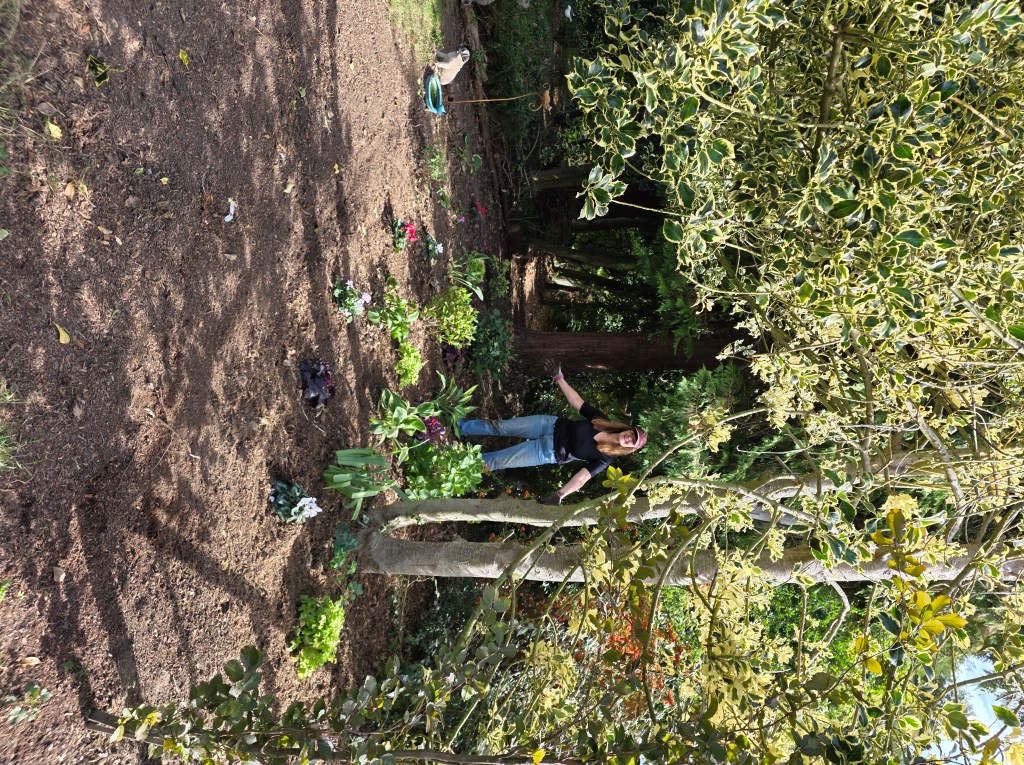
With the prospect of another warm day ahead, Karen and I set out to plant the new arrivals she’d bought at the garden centre yesterday. The goal was to finish off the border we’d recently reclaimed from a wild, tangled jungle of nettles, brambles, and ivy—basically, a complete mess all fighting for light.
I enjoy gardening up to a very specific point. The moment I hit that threshold, I want to pack my tools away, wash my hands, and do literally anything else. Karen, on the other hand, possesses no such threshold. She will continue gardening until whatever job she has started is fully complete.
The real complication is that while her hands are physically working on one task—planting up the new border today—her brain is already drafting a project charter for the next one, which currently involves laying an entirely new terrace. She has no garden off switch.
I have to admit, Karen’s approach to land management is vastly superior to mine. At least under her regime, jobs actually get finished.
By lunchtime, we had transformed the border, and I had firmly reached my limit. We sat out in the warm sun enjoying our lunch, quietly pleased with our morning’s labour. It was then that I caught myself looking across the lawn and realising that our shiny new border had exposed one of my own long-neglected half-jobs: the ornamental trees sitting in pots.
Actually, it wasn’t just the pristine border that highlighted these poor, forgotten trees; it was also a comment Karen had made about her trip to the garden centre.
Apparently, several plants there had looked so sad, dry, and pushed into dark corners to wither away that she’d felt compelled to report the management to the plant equivalent of the RSPCA—the RSPCP, presumably. Looking at my own potted trees, I realised that given half a chance, they would probably lodge a formal complaint against me too.
Karen, naturally, already had a recovery plan mapped out. She had clearly been mulling over the state of my arboricultural neglect while waiting for the optimal moment to raise it.
“How about we transplant the Oak into the spare green pot, split the Bamboo into the pot the Oak comes out of, and move the Wisteria into the pot that…”
It was at this exact juncture that my brain completely zoned out. We hadn’t pre-briefed this, and her tactical plan was infinitely more intricate than mine. My strategy had simply been to give them a splash of water, offer some gentle words of encouragement, and draft a future project plan. After all, I had crossed my threshold hours ago.
“So, where does this small conifer go now?” I enquired gently, trying to stay involved.
“Try it next to the other conifer-type tree,” Karen instructed, having mapped out an entire rehabilitation ward where the sad trees could recover.
By 5:00 PM, even Karen had finally reached her gardening limit for the day. The trees looked distinctly happier in their new homes with fresh soil, I felt relieved to have averted a raid by the RSPCP, and Karen was pleased that the garden looked balanced and tidy.
We had both achieved a synchronised state of domestic satisfaction. But as we walked up the steps onto the deck, Karen dropped a subtle hint:
“So… shall we lay that new terrace next weekend, then?”
Her brain had been building that terrace all along.


Leave a comment