With Freddie’s new baby sister due to arrive any day now, Fred naturally seizes every opportunity for some dedicated, uninterrupted time with his G’dad and G’ma. So, what better way to secure our undivided attention than an irresistible offer of Sunday lunch? In truth, he didn’t need a culinary bribe—we welcome any chance to spend time with him.
I was genuinely surprised to find my previous Lego construction project—a formidable three-foot-tall tower—still standing completely intact. Usually, my creations survive a matter of hours before facing total demolition, but this particular skyscraper had proven to be my most indestructible build to date, capable of withstanding even the most chaotic of Freddie’s games.
Fresh from our own domestic renovation victories—and now fully certified in the high-stakes art of picture-hanging—I was more than ready for today’s engineering challenge.
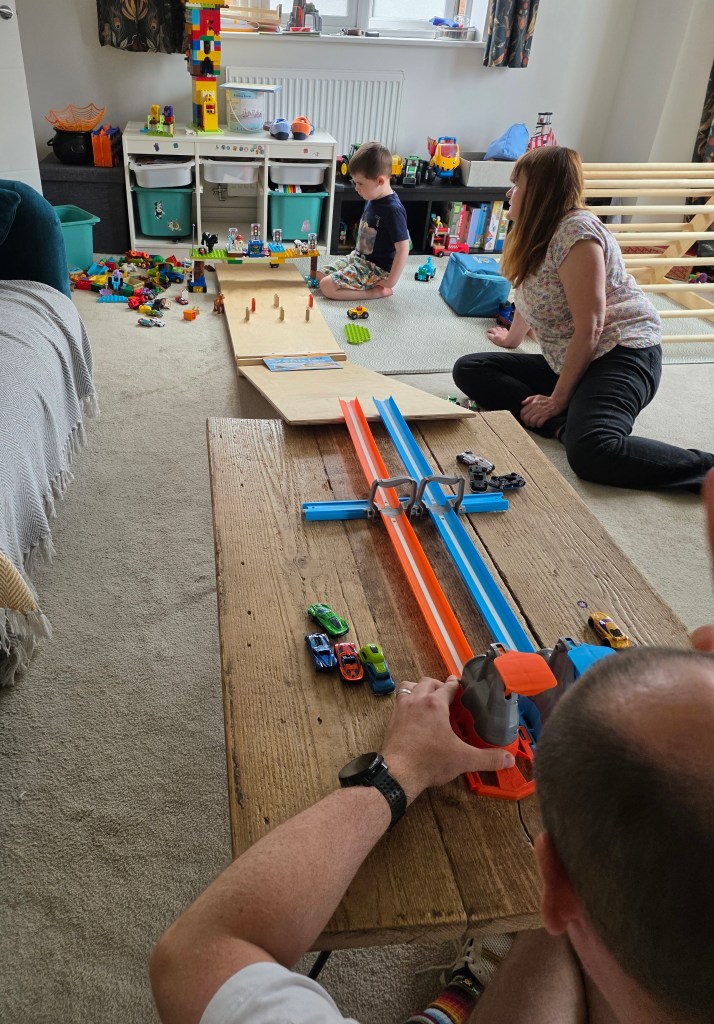
Freddie’s construction brief was delightfully straightforward: “Construct a bridge over the Hot Wheels race track.”
Once we had satisfied ourselves that formal planning permission and Building Control sign-offs were not required, we commenced the construction phase. Karen opted for modern modular building techniques using Magnet Tiles, while I stuck to traditional load-bearing materials: plastic Lego bricks.
Jack assumed the role of Chief Track Engineer and Head of Launch Control. Meanwhile, as Overall Project Manager, Freddie meticulously supervised the site, ensuring that every essential character—including tigers, deer, elephants, Lego men, and Lego women—was integrated into the structure. Naturally, given the sheer size of the workforce on site, a Lego toilet was also deemed mandatory.
With no foundations to excavate, no geological surveys to conduct, and no public notices to post, construction progressed significantly faster than our bungalow renovation. In record time, we were ready for the structural testing phase.
Yet, true to any grand British infrastructure project—I’m thinking HS2 in particular—the client suddenly scaled back the brief and radically re-prioritised the deliverables. In addition to the bridge span (a technically demanding feat of engineering given the materials), the Project Manager now insisted that all racing cars must come to a halt directly beneath the original tower.
The Chief Engineer made immediate micro-adjustments to the track’s angle of trajectory using a tried-and-tested piece of precision children’s engineering equipment: a hardback copy of Where’s Bluey?. We were ready for the launch sequence.
Freddie was adamant that today’s launch protocol required a count up rather than the standard NASA countdown from five. We counted alongside him, wondering at what precise integer Jack would press the release button.
“…Ten!” Freddie shouted. “Go, go, go!”
The first vehicle hurled down the ramp. It remained on the plastic track for mere microseconds before going fully airborne, clearing the bridge, narrowly missing an elephant bystander, flying over a tiger, and landing miles beyond the designated drop zone. The angle of trajectory clearly required recalibration.
With the Where’s Bluey? manual realigned, the subsequent cars zoomed smoothly down the incline, swept beneath the bridge, and landed precisely on target.
Official racing was scheduled to commence immediately after dinner. Freddie would remain in sole charge of Launch Control, while G’ma and I were under strict instructions not to tamper with the infrastructure. Our assigned roles as Race Marshalls were simple: retrieve the runaway vehicles.
I suspect that once dinner is cleared away, today’s civil engineering marvel will be summarily decommissioned and dismantled, making way for ‘The Shopping Game’. But for a brief, glorious hour, our Lego bridge stood as a monument to modern transit.

 Forwards and occasionally sidewards - everyday musings of life
Leave a comment